

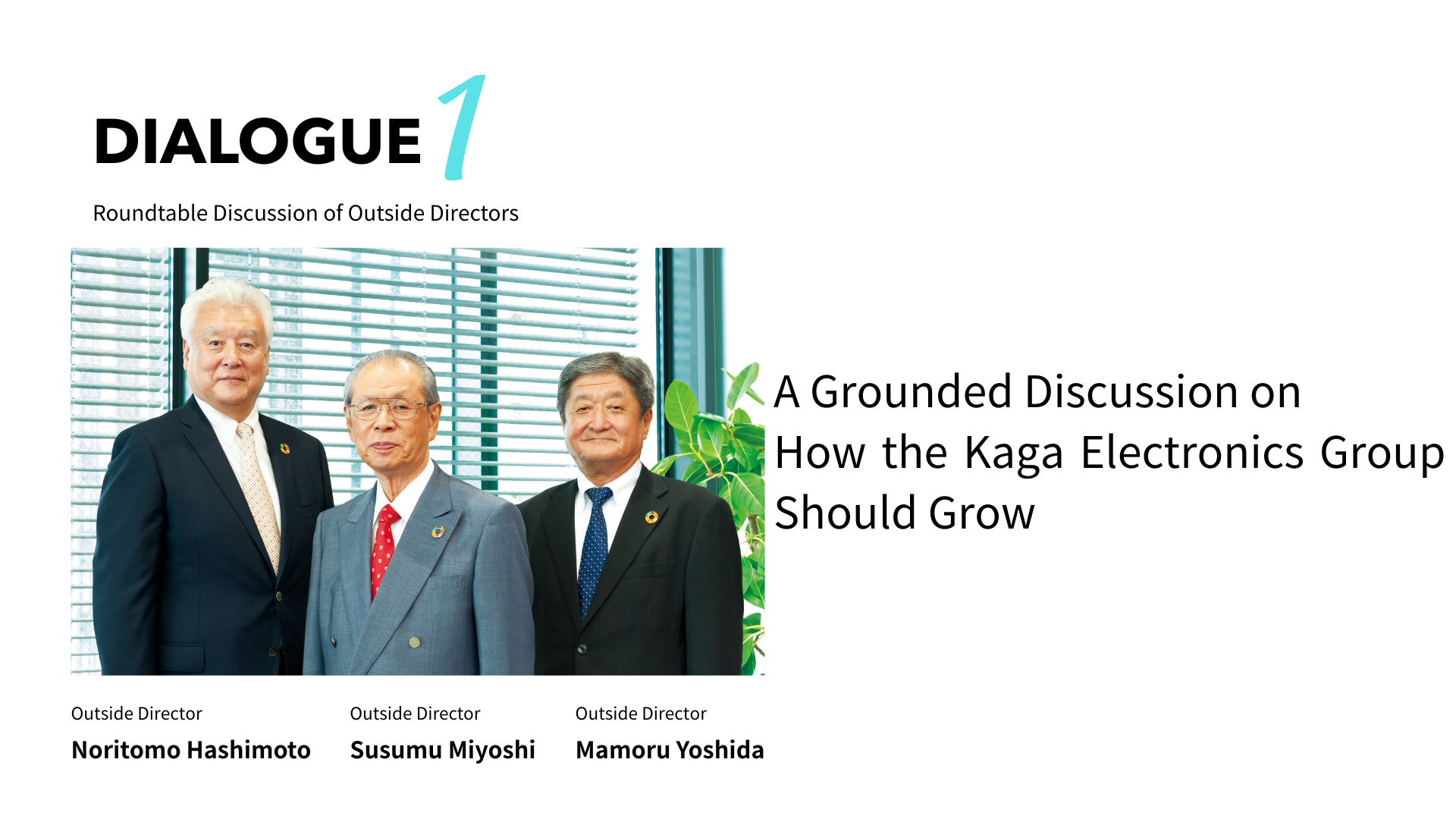
Here, we present a summary of a roundtable talk among our three outside directors, Susumu Miyoshi, Noritomo Hashimoto, and Mamoru Yoshida, in which they discuss topics pertaining to the Kaga Electronics Group’s future, including deliberations held during Board of Directors meetings in connection with the formulation of its Medium-Term Management Plan.
Investor RelationsInvestor Relations
Investor RelationsInvestor Relations

- IR
- IR Library
- Roundtable Discussion of Outside Directors
Roundtable Discussion of Outside Directors
Miyoshi
In the course of our deliberations on the plan, I suggested conducting a “portfolio analysis” in order to take stock of the products and services at the Company’s disposal. By thus obtaining a clear understanding of the Company’s strengths and weaknesses, we were able to secure a better overall view of the situation. Having done so, the first key step was to clarify the direction in which the Company is heading and the areas it will focus on going forward. Next, the Company needed to clarify its commitment to its stakeholders—employees, customers, shareholders, business partners, and the local community—and to establish quantitative targets. For shareholders in particular, it is important to strive toward higher targets, aiming for a consolidated dividend payout ratio of between 30% and 40% and ROE of 12% or higher. The relationship between ROE and capital costs must also be carefully assessed and addressed. In addition, I have voiced my desire for the careful consideration of what should be done to improve capital efficiency.
When pursuing specific initiatives, the growth potential of existing products must first be assessed. For the Company to achieve its ambitious target of achieving ¥1 trillion in net sales, it will need to vigorously introduce new businesses like that involving small wireless module production. Then comes M&A. Although the Company recently placed a tender offer bid (TOB) for Kyoei Sangyo Co., Ltd., two or three similar deals are needed. When promising opportunities arise, the Company must be poised to strike decisively.
The final point I emphasized dealt with the Company’s leveraging of its human resources. Amid discussions of leveraging the skills of Kaga’s senior employees and women and the employment of mid-career hires, engineers and foreign nationals, I drew attention to the growing importance of technological development and its particular role in empowering the Company’s engineers.
Hashimoto
The Company’s strength lies in the way it is able to perceive an issue and extend a helping hand to its customers before the competition even begins to notice an issue. In other words, it boasts higher business acumen than its competitors. The Company also believes helping customers to be the ultimate goal of business; a philosophy that is demonstrated in how its EMS business embraces striving to address the needs of customers, a trait that also yields about benefits for the Company. This is a mindset the Company takes great pride in and uses as it consistently strives to determine the best ways it can contribute to society.
Today, semiconductors are used in everything from home appliances to automobiles. We’re living in an age in which it is hard to find products that don’t contain semiconductors.
The Company’s strength as an electronics trading company lies in its unwavering support for its customers and confidence that it can handle anything and everything. I believe remaining steadfast in carrying on this spirit unique to the Kaga Electronics Group to be more crucial than simply achieving the medium-term management plan’s qualitative targets because of the plan’s unique structure. The Company is confident that it has sown enough seeds and will cultivate them throughout the fiscal year to ensure that future harvests will be exponentially bountiful.
In this context, it is absolutely essential that each and every employee never lose sight of how their individual efforts tie into the medium-term management plan. I am certain that as long as everyone clearly understands and pursues their roles, the Company will experience growth. We mustn’t allow ourselves to become so preoccupied with what lies ahead that we lose our critical thinking skills.
Yoshida
Having recently completed my first year as an outside director, I would like to share some particularly memorable points from a fresh perspective.
First, during deliberation and formulation meetings for Medium-Term Management Plan 2025, there were also discussions on the net sales target for fiscal 2030. The heads of each business company showed much enthusiasm and considered highly aggressive targets. Each site continuously strives to identify the challenges its customers face, and this commitment is the very embodiment of Kaga Electronics’ corporate philosophy: “Everything we do is for our customers.” Of course, while I recognize these goals will not be achieved easily and that many challenges lie ahead, I believe that framing each one from the perspective of challenges being the fuel to the fire of business and tackling them aggressively to be the best approach. I believe having management that takes a bottom-up approach to achieving ambitious targets, rather than a executive-led top-down approach, to be simply wonderful.
Touching on the portfolio strategy Mr. Miyoshi previously mentioned, our ongoing direct engagement with customers keeps us mindful of what solutions to provide in which business areas. Going forward, I would like to see deeper collaboration with new business areas and top-down M&A initiatives as well as enhanced cooperation among business companies.
Achieving net sales of ¥1 trillion is an extremely ambitious goal that will require a fundamental reform of management practices. I will continue to strive toward updating the Company’s corporate philosophy, values, and vision, sharing them throughout the entire organization, while contributing to the development of Groupwide strategies, the pursuit of excellence, management reform, and fostering a positive corporate culture.
Miyoshi
Bottom-up initiatives succeed because those on the front lines possess keen intuition that effectively translates top-level directives. From my position as an outside director, I’ve observed a “never-give-up spirit” permeating throughout the front lines, demonstrating remarkable tenacity. Such a company is truly resilient, no matter the circumstances. Going forward, I look forward to setting somewhat more ambitious goals and seeing the momentum build from the field as we strive to achieve them.
Hashimoto
Discussions during board meetings frequently centered on such topics as whether the overall net sales target should be ¥1 trillion or ¥800 billion and the scale of M&A that would be appropriate within said frameworks. As mentioned earlier, our front-line groundwork is thorough, so unrealistically high targets are never arbitrarily set. Whether results exceed or fall short of the target figures, a solid analysis of the current situation relative to the intended numbers is always conducted.
Essentially, if we fail to raise the overall level of growth, achieving our goals is unlikely. However, it’s not simply a matter of “let’s sell more”; the extent to which the EMS business can be expanded is also a crucial factor. The ideal approach is to pursue two parallel objectives: aiming for this level of growth even without M&A, and simultaneously exploring the potential for EMS expansion.
Miyoshi
The ¥1 trillion target is truly remarkable. While from our current position it may seem like a long shot, only by taking steady steps forward will we move closer to this goal. Moreover, the Company has the tools it needs at its disposal—there’s no reason not to aim higher.
While component sales are important, profits won’t increase without the added value component assembly brings. This is a major challenge to be addressed in the medium-term management plan.
While the EMS business primarily targets overseas markets, it represents a major asset for the Kaga Electronics Group. It is crucial for the EMS business to further evolve into the EDMS business, with the “D” standing for design, and to develop the capability to handle everything from planning and design to production and quality assurance in an integrated manner. From what I’ve seen during my visits to several overseas factories, processing capabilities are still insufficient. I do, however, have high hopes for KAGA ELECTRONICS (THAILAND)’s production base. If this base is able to further strengthen its capabilities, it will effectively raise the bar.
The upgrading and expansion of the EMS business will significantly contribute to the Group’s development.
Yoshida
The Company’s trading company business serves as a core part of its main operations. As such, without contributing to the success of its clients’ businesses, including the acquisition of new customers, sales growth cannot be achieved. Significant growth can also be driven by M&A, expanding business domains, or developing new ventures. However, the key to success in these endeavors lies in three essential elements: affinity for the business domain, human resources capable of operating the business, and the domain’s technology.
Regardless of the chosen approach, careful and objective consideration of the Group’s strengths, weaknesses, and available capabilities is essential. We outside directors are making various proposals and engaging in discussions while objectively assessing the Kaga Electronics Group’s strengths and challenges
Hashimoto
Taking on this new business feels like a very bold decision. It marks the Kaga Electronics Group’s first venture into developing, manufacturing, and selling its own branded devices. Should these products enjoy widespread adoption, they have the potential to transform the world. Once such products are developed, their reception in the market, strengths, and areas for improvement must all be closely tracked and analyzed. Only then can products that outperform competitors be created consistently. Sustaining such endeavors is impossible without the resolve to build a team of engineers dedicated to this purpose. In the world of manufacturing, unless you’re prepared to invest all of this year’s profits into technological development and human resource acquisition, you won’t survive. It’s that harsh.
Miyoshi
KAGA EMS TOWADA and KAGA ELECTRONICS (THAILAND) will work in cooperation to ensure that these small wireless modules will be manufactured entirely in-house. Both companies are leveraging their respective strengths with an eye to continuous improvement. I also applaud the achievement made possible through the intra-Group collaboration between KAGA FEI and EMS TOWADA as an example of the Company’s previously mentioned efforts to advance its EMS business. If this form of development continues to be realized, I believe it holds tremendous potential for growth as a Group.
Yoshida
Prior to the Group taking charge, we were told that while the products themselves were technologically advanced, there were challenges in terms of customer engagement. The Group’s strength, however, lies in its extensive customer reach and, by leveraging this strength, highly marketable products have been developed. This is a truly remarkable outcome. We believe this functional module business represents areas with significant growth potential, including marketability. However, looking to the future, software development will be crucial as will achieving the functionality customers demand and developing solutions.
The Kaga Electronics Group’s technical division will spearhead the development of high-marketability functional modules, and I hope that this will be cultivated into a major pillar of its business.
Miyoshi
I am outraged to my core. I loathe situations like this, and I am genuinely saddened by the lack of respect for human rights, a vital principle in and of itself. As this isn’t a widespread problem throughout the Company, it’s essential to seek proper guidance from an expert. While the Company does employ the use of suggestion boxes to gather employee feedback and opinions, they aren’t being utilized effectively, making it imperative that they be improved.
Hashimoto
As chair of the investigation committee, I compiled the results of a thorough inquiry into the facts along with recommendations for reoccurrence prevention measures and reported them to the Board of Directors. While this incident is certainly infuriating, I believe it is essential to first fully grasp what led to it happening.
In this case, I got the distinct impression that the Company placed the entire burden of growing its EMS business overseas on the shoulders of a single local manager. Generally, overseas operations are handled by teams of 5 to 10 Japanese supervisors managing anywhere from 100 to 200 local employees, meaning that each individual ends up juggling multiple responsibilities. Because they are relatively few in number, regardless of age or seniority, each supervisor is forced to bear the heavy responsibility of becoming a key player in solving issues the Company’s faces.
Furthermore, I believe entrusting the site to the same supervisor for over a decade was problematic in itself. No matter how capable someone is, being stuck in the same position for more than ten years would make anyone weary. One would understandably become frustrated if they felt that any chance to take on new opportunities just passed them by.
As the EMS business will clearly remain the backbone of the Company going forward, it is imperative that this incident be taken seriously. The Company must thoroughly examine how to resolve this issue, engage in candid discussions, and implement organizational reforms to prevent any reoccurrence.
Miyoshi
It is regrettable that those in leadership positions either overlooked or failed to provide guidance on this matter. Rather than acting solely in their own best interests, supervisors must learn to control their frustration in the moment and take measured steps to nurture their team. Officer training must be thoroughly implemented to ensure leaders are capable of properly supporting their subordinates.
I also believe that because of the “five-year rotation” stipulated in the Company’s Employment Rules, the Personnel Department shares some responsibility for allowing the supervisor to remain in the position for so long.
Hashimoto
While it’s true that the supervisor overstaying their position was part of the problem, this presents a genuinely difficult issue. If the five-year rotation policy were strictly enforced, we run a high risk of local employees perceiving supervisor placements as merely temporary assignments, which would hinder managerial effectiveness.
Miyoshi
In that regard, ultimately, overseas projects won’t succeed unless local employees are placed in top positions. China has already reached that stage, and I’ve told the officer in charge that, even if it takes time, we have no choice but to move in that direction.
Yoshida
It is extremely important, as Mr. Hashimoto mentioned, for all executives to thoroughly discuss what the Company should stand for as an organization and to establish as a shared value the principle that no line should be crossed—particularly with regard to human rights. KAGA ELECTRONICS CO., LTD. aims to establish a corporate philosophy revolving around a people-centered approach and that values individuals, embedding this ethos into its corporate culture. As such, the Company also seeks to provide guidance to the affected parties on ways to bounce back from this incident.
I wish to convey to those in top management positions the importance of always maintaining a spirit of gratitude and humility.
Hashimoto
Nurturing the EMS business overseas is an absolute priority for the Company. Tackling the management of overseas bases and factories head-on to ensure such incidents never happen again will undoubtedly be a crucial step toward securing the Company’s future—a step that it can look back on as the point its business began to truly evolve.