

“Why do companies exist?” Even from the Company’s humble beginnings, I have maintained that while I may be the founder, the Company does not belong to me. It belongs to our hardworking employees and exists as the place where they earn their living. This is why we at KAGA ELECTRONICS emphasize complete transparency in our management.
The way I see it, our employees are cherished partners with whom I share common values. Therefore, I operate from the basis of a “share the wealth” sort of mentality when it comes to those who diligently and creatively work every day to generate profits for the Company. This creates an atmosphere of “collective management” that gives employees a sense of ownership in the Company as they tackle their day to day tasks.
Also important to my management attitude is a determination to not mix business and personal matters. Given that our employees work so very hard, it is naturally incumbent upon
the Company to value them and their efforts while maintaining clear and open channels of communication.
Companies that exist for the sake of their employees is a concept that stands the test of time simply because without hardworking employees, companies do not survive. Therefore,I remain firm in my belief that employees must always be valued.
As Founder, I take the recent incidents of harassment by some executives and employees very seriously. These incidents have reaffirmed my conviction that maintaining a safe and comfortable work environment must be the most fundamental stance of the Group.
Investor RelationsInvestor Relations
Investor RelationsInvestor Relations

- IR
- IR Library
- Integrated Report (Message from the CEO)
Integrated Report (Message from the CEO)
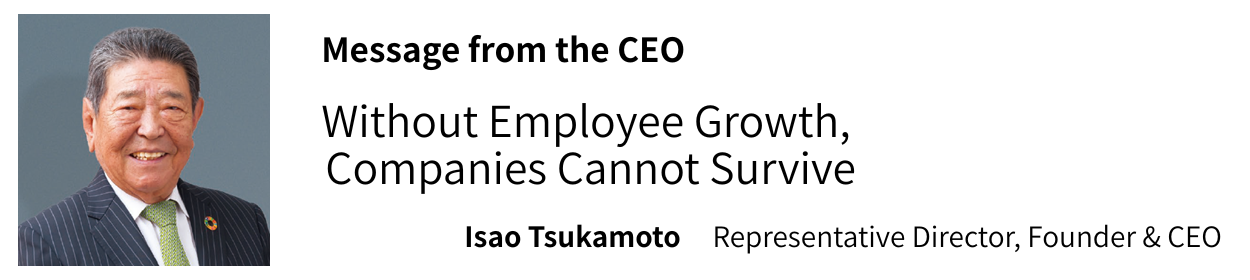
Around the time I founded the Company in 1968, engineers from electrical equipment manufacturers would personally visit Akihabara to purchase the parts they needed to build prototypes. Once I learned this, I began leveraging our Akihabara office location, which was only about 6.6 m², attracting customers with this simple sales pitch: “It takes just a single phone call— we’ll gather and deliver any and all of the parts you need.” As our client base gradually expanded, we began receiving more and more inquires from businesses across various industries that catered to their specific needs.
“Everything we do is for our customers,” and “Never say ’no’ to our customers,” have been our cornerstone philosophies since our days as a handyman business. Over time, our customers came to appreciate our drive and procurement capabilities, which made it possible to source items unavailable in Japan, even going so far as to cross the ocean to find them. Our services went on to evolve further, going from simple parts procurement to meeting the needs of the era by providing kitting services and processing parts into units. This ultimately led to the current EMS business and is the origin of the Kaga Electronics Group's unique monozukuri, or manufacturing capabilities.
On the other hand, I often hear it said that the internet-dependent nature of contemporary society has made trading companies obsolete. However, during the semiconductor shortage, a customer of ours faced a production crisis because they couldn’t find even a single semiconductor. Thankfully, we were able to leverage our global network and somehow secure it for them, but situations like this are not unusual and can happen at any time in the real world.
Currently, global manufacturers face strong demands from capital markets for capital efficiency even as the semiconductor and electronic components industry undergoes repeated intense cycles of prosperity and decline and is buffeted by heightened geopolitical risks as well as unpredictable shifts in industrial and trade policies. Consequently, manufacturers are increasingly relying on external sourcing and thus converting to modules and units.
At our founding, there were nearly 1,000 distributors of various size. Today, that number has been whittled down to around 200. So, how has Kaga prevailed? The answer lies in the human connections that we began cultivating more than 50 years ago as well as the capabilities of our employees.
It is because we are a Group that acts on behalf of our customers—a unique trait of the Kaga Electronics Group that competitors cannot replicate overnight. I also firmly believe that a lot of the credit should go to our strong adherence throughout the Group to a founding philosophy that posits a company simply cannot survive without employee growth.
KAGA AEROSYSTEMS CO., LTD., our consolidated subsidiary, signed an agreement with Wakayama Prefecture in August 2025 concerning cooperation in aircraft transport activities during large-scale disasters (hereinafter referred to as “this agreement”).
This agreement aims to enable the company, upon request from Wakayama Prefecture, to transport relief supplies such as daily necessities, as well as the personnel and equipment necessary for implementing emergency disaster countermeasures—including doctors—via helicopter, in the event of a large-scale disaster such as a Nankai Trough mega-earthquake occurring within Wakayama Prefecture and disrupting land transportation.
The company operates rotary-wing aircraft businesses based at Wakayama Prefecture’s Nanki-Shirahama Airport, including helicopter operation contracting, aircraft maintenance,
pilot training, and the import, export, sale, and leasing of aircraft and related equipment and parts. Since December 2022, the company has been contracted by Wakayama Prefecture to operate the “Kishu” firefighting and disaster prevention helicopter. Accordingly, in March 2023, the company received from the prefecture a new aircraft manufactured by Bell Textron, Inc. of the United States, featuring enhanced safety features configured for this purpose.
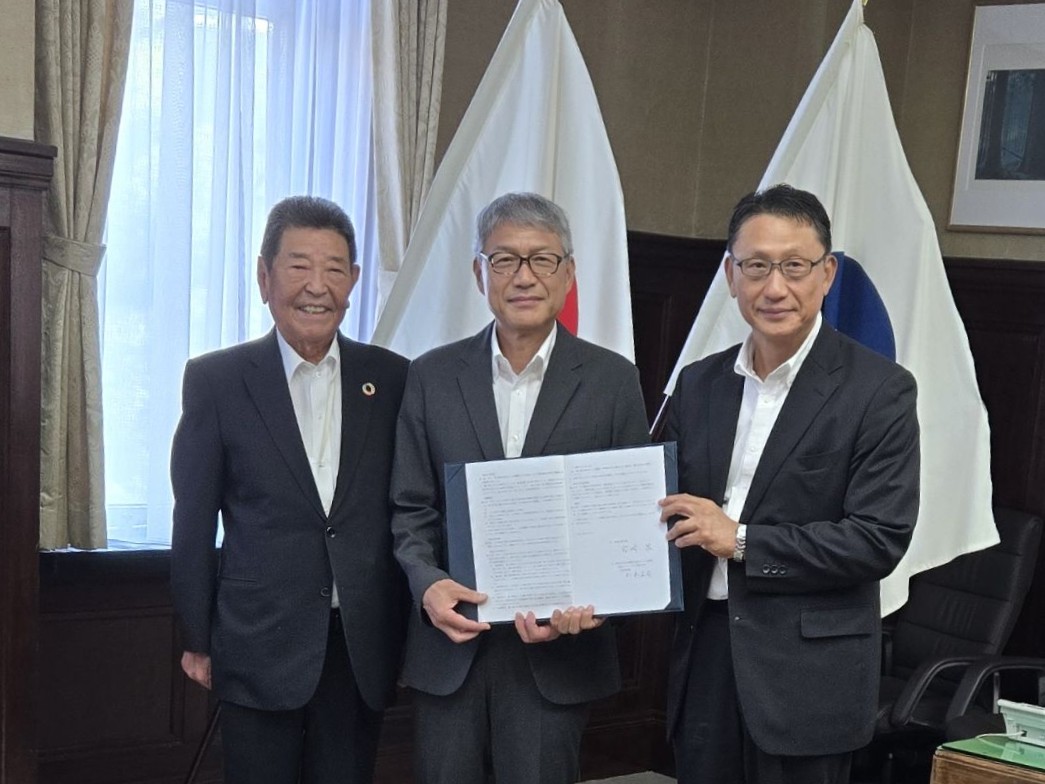
Center: Izumi Miyazaki, Governor of Wakayama Prefecture
Right: Masashi Sugimoto, President and Representative Director of KAGA AEROSYSTEMS