The Kaga Electronics Group considers the promotion of CSR and sustainability as its key management issues and has formulated a Medium- to Long-Term Sustainability Management Plan in 2021. In particular, we are currently advancing our contribution to the global environment by reducing CO2 emissions and promoting waste reduction and reuse through our business activities, and offering environmentally friendly products and services. Furthermore, we have set “creating a clean global environment” as one of our material issues and are working to address climate change, and we recognize significant transition risks, physical risks, and opportunities in accordance with the TCFD recommendations framework. Our implementation policies are as follows.
SustainabilitySUSTAINABILITY

- Sustainability
- Environment
- Climate Change
Climate Change
Basic Approach
Status of Implementation of TCFD Recommendations
Governance
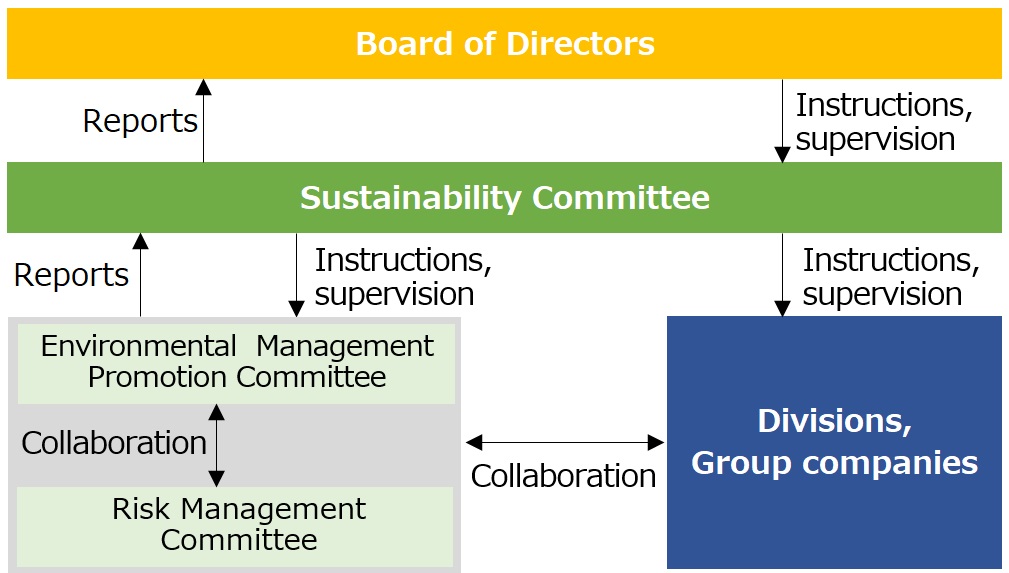
The Group established the Sustainability Committee by integrating and consolidating the former CSR Committee and SDGs Committee in April 2024 to enhance the Group’s overall corporate value through the implementation of cross-group initiatives that address medium- to long-term management issues related to the environment, society, governance, and other areas. Under this committee, we have established six specialized subcommittees, including the Environmental Management Promotion Committee and the Risk Management Committee.
The committee meetings are held once every six months, in principle, and the committee is composed of the President and COO as the Chairperson, executive officers overseeing each division as committee members, and the Sustainability Promotion Department serving as the secretariat. The secretariat is responsible for the collection, disclosure, and reporting of information related to the Group’s sustainability promotion activities, as well as other activities that support the operation of the committee for facilitating the holding of committee meetings in collaboration with each specialized subcommittee.
The roles of the committee include the deliberation of sustainability-related issues identified by specialized subcommittees such as the Environmental Management Promotion Committee, the formulation of strategies and targets and the implementation of measures for the Group's ESG issues, including those related to climate change, and the monitoring of their progress.
The matters considered and resolved by the Sustainability Committee are reported to the Board of Directors each time. The Board of Directors then consults with the committee on the matters reported and provides instruction and oversight on the initiatives implemented by the committee.
●Climate change-related organizational chart
Strategy
Analysis process
We examined the risks and opportunities posed by climate change regarding the Group’s business operations in the following steps, with reference to the items of risks and opportunities presented in the TCFD recommendations.
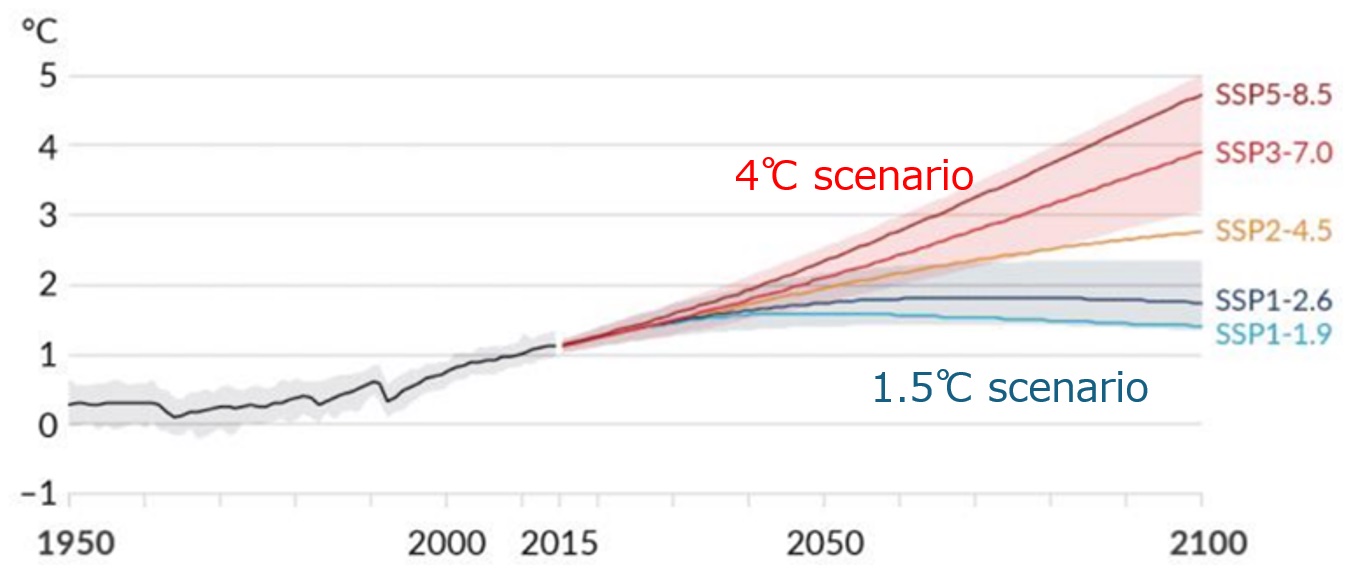
Moreover, we conducted an analysis of the transition of policies and market trends (transition risks and opportunities) and an analysis of physical changes due to disasters and other factors (physical risks and opportunities), using two scenarios, a 1.5°C scenario and a 4°C scenario.

Climate change scenarios
●1.5°C scenario (decarbonization scenario)
A scenario that aims to limit the increase in global surface temperature to less than 1.5°C compared to pre-industrial levels, by accelerating initiatives aimed at achieving carbon neutrality to mitigate the impacts of climate change. In the 1.5°C scenario, it is assumed that the impact of policy and legal risks among transition risks will be greater, compared to the assumptions regarding those risks in the 2°C scenario.
●4°C scenario (high emissions scenario)
A scenario in which measures against climate change do not progress from the current state, resulting in a global surface temperature rise of approximately 4°C by the end of this century compared to pre-industrial levels. It is assumed that the impacts of intensifying extreme weather events and sea level rise on physical risks will increase.
●Global surface temperature change relative to 1850–1900
Source:
This figure is a reproduction of Figure SPM.8 from the Summary for Policymakers of the Working Group I (WGI) contribution to the Intergovernmental Panel on Climate Change (IPCC) Sixth Assessment Report (Ministry of Education, Culture, Sports, Science and Technology and Japan Meteorological Agency)
Impact assessment of risks and opportunities and selection of countermeasures
In the 1.5°C scenario, it is expected that the decarbonization of fuels and raw materials will advance due to intensifying external pressures for decarbonization, leading to a rise in procurement costs and costs associated with compliance with emissions regulations. On the other hand, customers will increasingly demand energy-saving and low-carbon products, so we expect to see growing demand for existing businesses, such as the reuse and recycling of power semiconductors and information devices that contribute to energy efficiency, as well as the acquisition of new business opportunities through the implementation of emission reduction measures.
In the 4°C scenario, low-carbonization and decarbonization initiatives are expected to be promoted; however, their effects will be limited, leading to rising trends in CO2 emissions. This situation is likely to result in an increase in extreme weather events and disaster risks. Consequently, incidents such as damage to manufacturing sites and disruptions in the supply chain are anticipated, making it necessary to strengthen Business Continuity Planning (BCP) measures, including those involving external partners.
We are aware of the major transition risks and physical risks and earnings opportunities relating to climate change as follows.
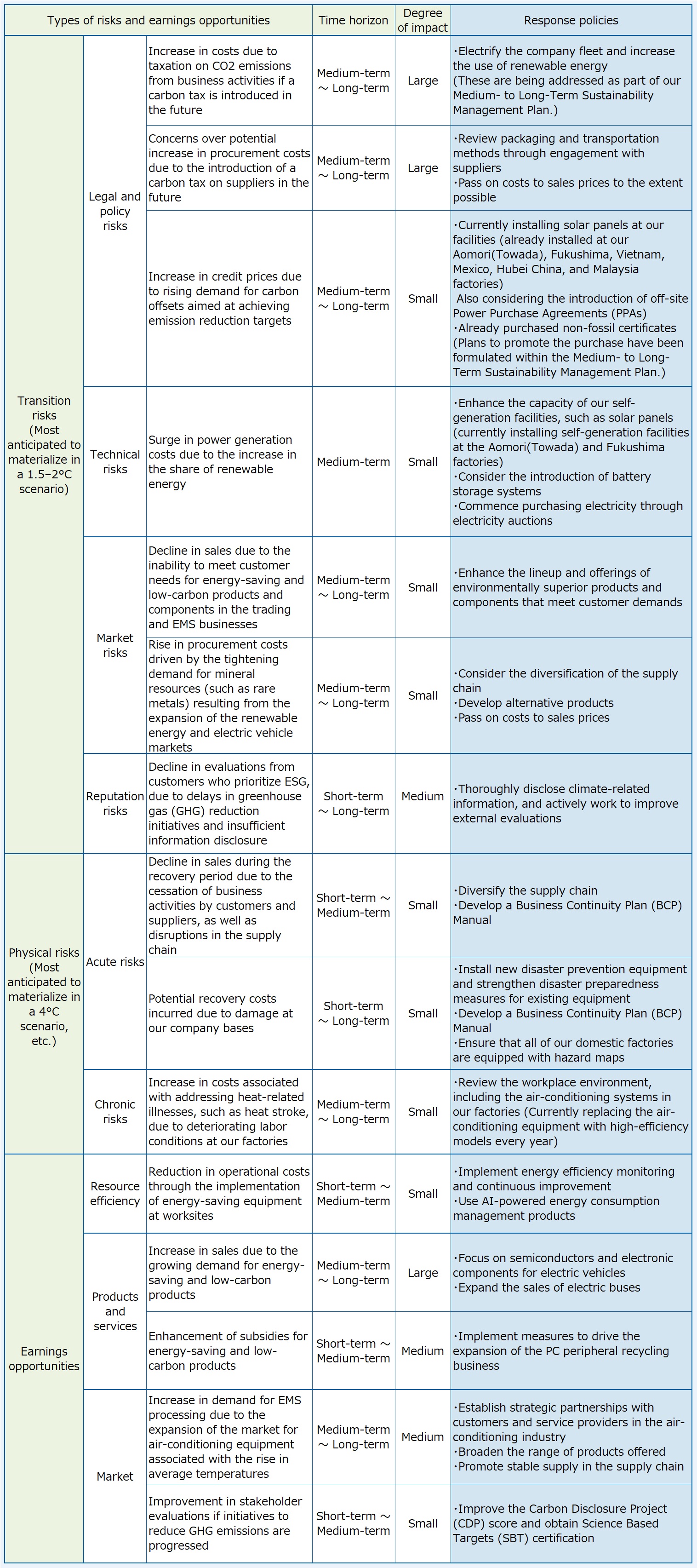
・Time horizon:Short-term: up to 3 years, Medium-term: 3 to 6 years (2030), Long-term: 6 to 26 years (2050)
・Degree of impact:Large: 10% or more of operating income, Medium: 3% to 10% of operating income, Small: Less than 3% of operating income
Risk management
Process for classifying, evaluating, and managing climate-related risks
We have established the Environmental Management Promotion Committee as a specialized subcommittee directly under the Sustainability Committee. Each department and group company identifies short-term and medium- to long-term risks associated with climate change. The Environmental Management Promotion Committee then classifies and evaluates these risks, and reports the particularly significant ones to the Board of Directors through the Sustainability Committee every six months.
With regard to the classified and evaluated climate change-related risks, the Environmental Management Promotion Committee considers preventive measures and response policies. After deliberation and decision by the Sustainability Committee, these measures and policies are implemented by each department and group company. Furthermore, we comprehensively evaluate the importance and prioritization of risks from the perspectives of impact and urgency. The Sustainability Committee also reports on these matters to the Board of Directors in a timely and appropriate manner.
Integration process into Group-wide risk management
The Risk Management Committee overseeing Group-wide risks has been established as a specialized subcommittee directly under the Sustainability Committee. It designates a department to address each specific risk, and under the direction of the department's risk control officers and managers, a necessary and appropriate risk management framework is established. With regard to climate change-related risks, the Environmental Management Promotion Committee and the Risk Management Committee are working in collaboration to establish an integrated Group-wide risk management system.
Metrics and targets
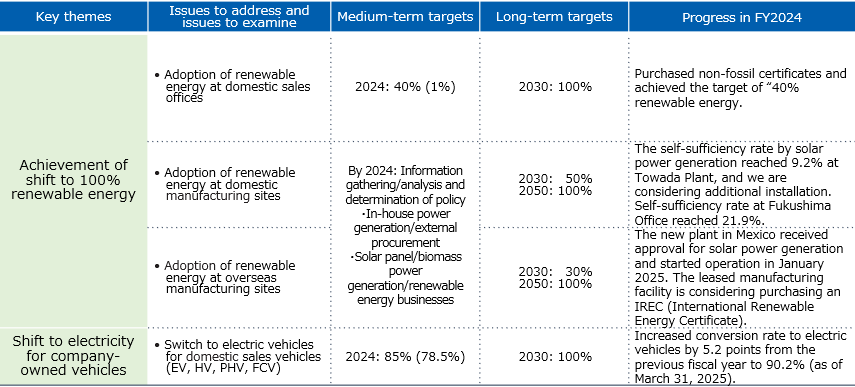
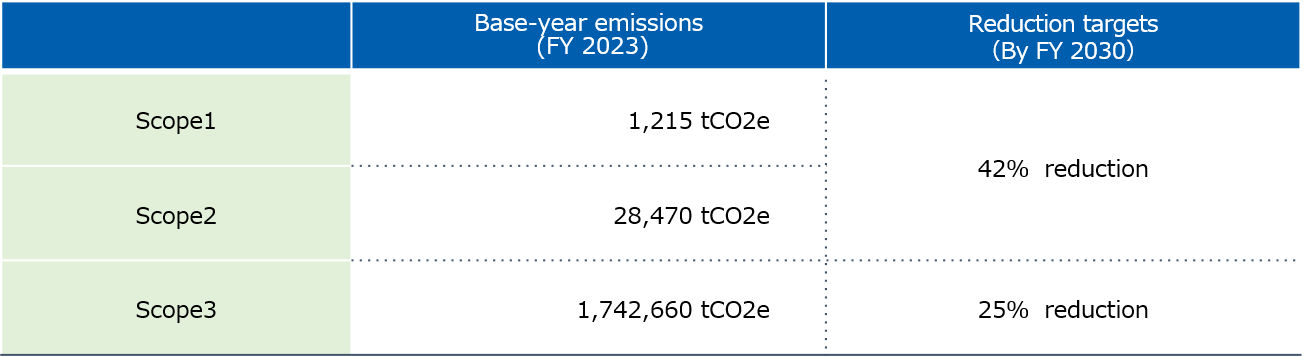
The Group has calculated Scope 1, 2, and 3 emissions for the fiscal year ended March 31, 2024. As a result, we have set a reduction target of 42% for Scopes 1 and 2 and 25% for Scope 3 by 2030, based on the fiscal year ended March 31, 2024.
The Group is committed to understanding the current situation and working toward achieving its goals.
Progress
The Group has established the Medium- to Long-Term Sustainability Management Plan (announced on November 25, 2021) and is targeting the “achievement to shift to 100% renewable energy” and “shift to electricity for company-owned vehicles” to address environmental issues relating to the reduction of GHG emissions. The medium- and long-term targets for the main KPIs and progress in FY2024 are shown below.